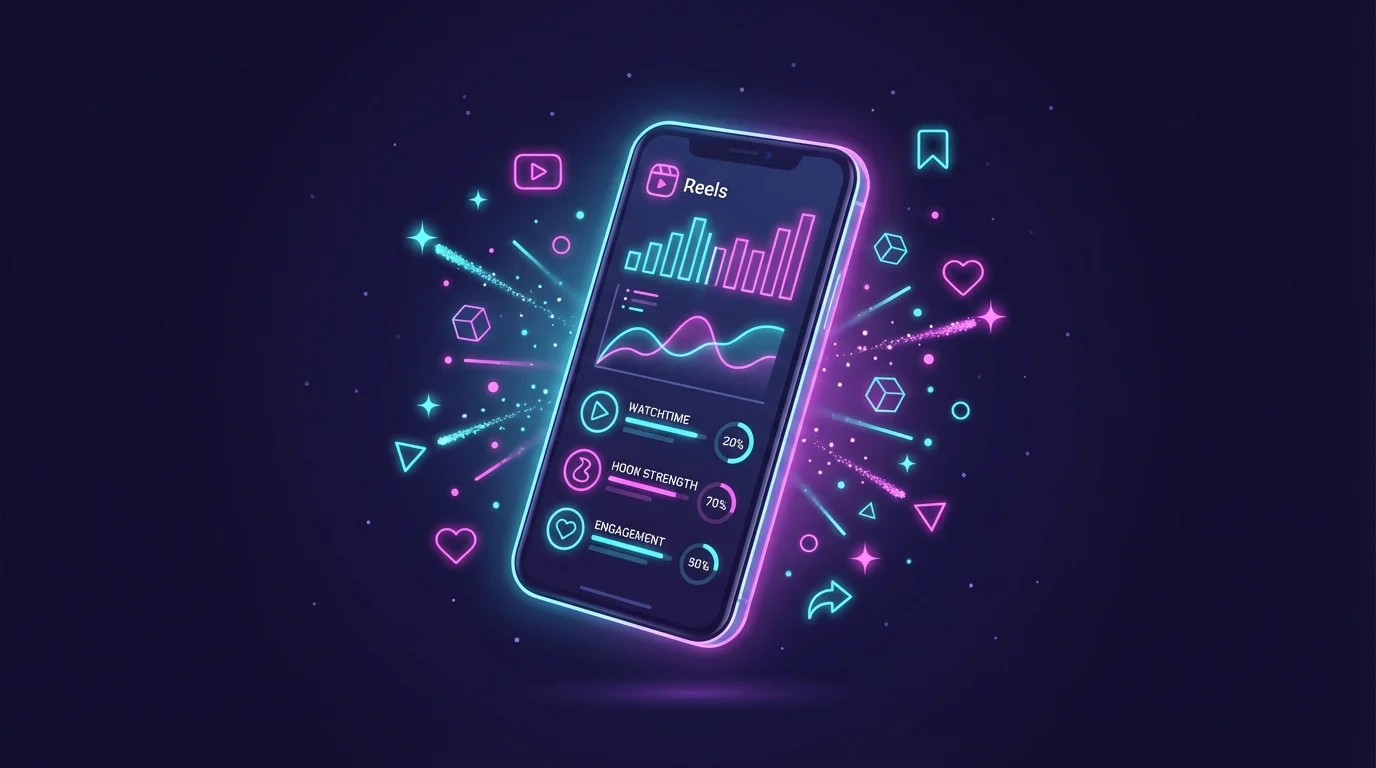
- The Reels algorithm evaluates 6 signals: watch time, completion rate, saves, shares, trending audio, and account consistency.
- The first 2 seconds decide everything. A weak hook kills any clip — no matter how good the rest is.
- Saves and shares are more valuable than likes because they signal to the algorithm that your content has lasting relevance.
- Trending audio gives your Reel an algorithmic boost when you use it within the first 72 hours of its rise.
- With AI analysis you can see exactly which second viewers are dropping off — and fix it right there.
How the Instagram Reels Algorithm Works: The Test Mechanism
Instagram starts by showing every new clip to a small test group. Not your followers — accounts that match your niche topically. This first round is the decisive filter.
During this phase, the algorithm collects signals. Does the test group watch to the end? Do they share the clip? Save it? Comment on it? Watch it twice? When the signals are strong, Instagram expands distribution — first to the Explore page, then into non-follower feeds, then potentially viral.
Adam Mosseri, CEO of Instagram, confirmed in a 2025 creator briefing: Reels are evaluated based on their performance in the first 24 to 48 hours. Content that does not send clear signals in that window will not be distributed further — regardless of how well it might have performed later.
This means your goal is not to produce a perfect video. Your goal is to produce a video that sends strong signals within the first 48 hours.
The 6 Ranking Signals at a Glance
Based on internal information from Meta and independent analysis by Socialinsider, the Reels algorithm evaluates the following six factors:
1. Watch Time and Completion Rate: How long do viewers watch? Do they finish the video? Do they rewatch it? Completion rate is the single strongest lever. According to Socialinsider's Reels Benchmark Report 2025, Reels with a completion rate above 70 percent are three times more likely to be shown on the Explore page.
2. Engagement Quality: Saves, shares, and comments count more than likes. A Reel with 50 saves and 200 likes outperforms a Reel with 5 saves and 500 likes. Saves signal long-term value; shares signal social relevance.
3. Hook Strength: What happens in the first 2 seconds? The algorithm measures drop-off rate at the second level. A Reel that has already lost 40 percent of its test group by second 2 will not be distributed further. Full stop.
4. Originality: Since 2024, Instagram has actively penalized re-posts that carry watermarks from other platforms — this primarily affects videos exported directly from TikTok. Original content wins, and that applies to audio too: self-created sounds are ranked higher than third-party tracks.
5. Trending Audio: Reels that use trending audio within the first 72 hours of its rise get an algorithmic boost. Too early provides no benefit; too late doesn't either. The window is surprisingly narrow.
6. Account Consistency: Instagram evaluates whether you post reliably. Someone who posts daily for three weeks and then disappears for two weeks loses the algorithmic trust they built up. According to Meta's creator guidelines, accounts with regular activity are clearly favored.
Watch Time and Completion Rate: The Strongest Lever
No other signal is as directly correlated with reach as completion rate. A Reel that gets watched all the way through tells the algorithm: this content delivers on its promise.
Here is how to optimize watch time:
Loop structure: The clip ends in a way that flows seamlessly back to the beginning. Viewers often do not notice when the loop restarts, so they watch it multiple times. This multiplies your average watch time per person.
Information density: Keep the pace of information high. Every second needs to deliver value. Silence, slow transitions, and empty intros are drop-off points.
Cliffhanger structure: Save the most important information for the end. "I'll show you the result at second 14" keeps viewers watching. This technique works especially well for tutorial and reveal formats.
The optimal length depends on the format. According to Later.com data from Q4 2025, Reels under 15 seconds achieve an average completion rate of 78 percent. Reels between 30 and 60 seconds come in at 54 percent. Reels over 90 seconds at 31 percent. Shorter Reels are not automatically better, but they have a structural advantage when it comes to completion rate.
The Hook in the First 3 Seconds: Your Only Entry Point
65 percent of all Reels drop-offs happen in the first three seconds. That is not industry folklore — it is a metric Meta has communicated internally. Lose those three seconds and you lose the algorithm.
A hook needs to trigger one of three reactions:
Curiosity: "I didn't know that" or "I want to know that." Phrases like "The mistake 90% of all creators make" or "Why nobody is watching your Reels" create cognitive pull.
Surprise: An unexpected claim, a counterintuitive result, a visual disruption. The brain responds to anomalies and automatically stops scrolling.
Direct value: "In the next 30 seconds you'll learn how to do X." This works for tutorial content because the viewer immediately understands the trade-off: I give 30 seconds of attention, I get X in return.
For more hook strategies and concrete templates for Reels and TikTok: The First 3 Seconds: How to Hook Viewers on TikTok
Want to check your video before posting?
Try Go Viral FreeSaves and Shares: The Engagement That Actually Counts
Most creators optimize for likes. The algorithm optimizes for saves and shares.
Saves signal long-term value: the viewer wants to find this content again later. That is the strongest signal for utility content. If your Reel contains useful information — tutorials, checklists, resources — ask explicitly for the save: "Save this, you'll need it."
Shares signal social relevance: the viewer sends the clip to someone or shares it to their Story. This extends your reach organically beyond your own feed. Shares are driven by emotional resonance — by content that makes someone say: "My friend needs to see this."
Comments are evaluated by quality. Emojis barely count. Short prompts like "What do you think?" generate surface-level engagement. Real dialogue — responding to comments within the first hour — sends a stronger signal to the algorithm.
Trending Audio: The Algorithmic Turbo
Instagram favors Reels that use trending audio — but only when the timing is right.
The trending audio window moves through three phases:
Rise (0–48 hours after it appears): The audio does not yet have enough data volume. No boost, but you are early.
Peak (48–120 hours): The optimal window. The algorithm sees that many creators are using this audio and gives preferential distribution to Reels with this track. A Reel published in this window can achieve 20 to 40 percent more organic reach than the identical Reel with a neutral track.
Saturation (120+ hours): The audio is spent. The boost is gone and your Reel is competing with thousands of others for the same attention.
How do you find trending audio early? Through the Instagram Audio Browser (Create Reel → Audio → Trending), through TikTok trending sounds (often 24–48 hours ahead of Instagram), and through creator accounts in your niche that are generating a lot of reach.
On originality in audio: if you create original audio and it goes viral, you are the source. Other creators use your sound, and every use is a direct algorithmic boost for your account. Accounts like @khaby.lame use this model deliberately.
Posting Frequency and Consistency: What the Data Says
One of the most common questions: how often should I post? The answer depends on your current account size.
Accounts under 10,000 followers benefit most from high frequency, according to Hootsuite Social Media Trends 2026. Three to five Reels per week gives the algorithm more test opportunities and builds account trust faster.
Accounts between 10,000 and 100,000 followers can achieve strong results with two to three Reels per week when quality is high. Here, consistency matters more than quantity.
Large accounts (100,000+) have enough account trust to sustain one to two Reels per week. Their test group is larger, which means a weaker clip causes less damage.
The most important thing: three Reels per week for eight weeks is far better than posting daily for two weeks and then going silent. Consistency over time is the signal that keeps the algorithm on your side long-term.
For a comparison with TikTok and YouTube algorithm dynamics and their posting frequency requirements: YouTube Shorts vs. TikTok vs. Reels: Best Platform in 2026
Using AI to Analyze Your Reels Content
You can keep all these signals in mind, but without objective data about your own video you will not know what is actually broken. This is exactly where AI analysis comes in.
Go Viral analyzes your Reels and TikToks and gives you scores for hook strength, watch time potential, visual energy, and storytelling structure — the exact factors the algorithm evaluates.
The result is concrete feedback: "Your hook is weak (Score: 41/100). First 2 seconds lack a clear promise. Recommendation: open directly with your strongest statement." No more guessing, no more "something feels off about this." Measurable diagnosis instead of gut instinct.
This is especially useful when you are testing a format and cannot figure out why one Reel performs and another does not. Analyze both in Go Viral and see exactly which signals differ.
For a detailed explanation of the Virality Score and how it is calculated: What Does a Virality Score Mean?
The Most Common Reels Mistakes That Kill Your Reach
Three mistakes creators make over and over again:
Mistake 1: Promotional intro. "Hey guys, today I'm going to show you..." is a guaranteed drop-off. The algorithm sees the spike in drop-offs at second 3 and stops distribution. Start directly with the hook — never with a greeting.
Mistake 2: Inconsistent niche. If you post fitness content this week, travel content next week, and cooking the week after, the algorithm cannot figure out who to show your content to. Your test group gets recalibrated every time. Stay in your niche.
Mistake 3: Optimizing only for likes. Likes are easy to give and weak as a signal. Build your content strategy around generating saves and shares. Ask yourself with every Reel: would I save this? Would I send this to someone?
For more hook formulas that stop the scroll and drive engagement, check out our guide: The 15 Best Hook Formulas for Short-Form Video
Conclusion: The Algorithm as a System, Not a Mystery
The Instagram Reels algorithm is not a mystery — even if it sometimes feels like one. It is a system with measurable inputs and largely predictable outputs.
The core formula is actually straightforward: strong hook in the first 2 seconds, high completion rate through dense content, saves and shares through genuine utility or emotional resonance, consistent posting within a clearly defined niche, and trending audio in the right time window.
Creators who approach these five points systematically build organic reach — even without a large follower base, even as a new account. The algorithm is not a barrier; it is actually a fair invitation: produce content that people genuinely want, and I will make sure it gets seen.
The only question that matters: do you know what your viewers actually want? And are you delivering it consistently?
Frequently Asked Questions
How does the Instagram Reels algorithm work?
The Instagram Reels algorithm evaluates every clip against six core signals: watch time (how long and how often someone watches), engagement quality (saves, shares, comments), hook strength in the first 3 seconds, content originality, use of trending audio, and account consistency. Content that performs well in these areas is first shown to a small test group. Strong signals lead to distribution on the Explore page and into non-follower feeds.
What is the most important factor for getting more Reels reach?
Watch time — specifically completion rate — is the single strongest lever. When more than 70 percent of your viewers watch a Reel all the way through, it signals high content quality to the algorithm. You achieve this with a strong hook in the first 2 seconds that raises a question or makes a surprising claim that compels people to keep watching.
How long should an Instagram Reel be in 2026?
Reels between 7 and 15 seconds achieve the highest completion rates because they tend to be watched multiple times. For deeper topics, 30 to 60 seconds works well if the hook is strong and the content delivers value throughout. Avoid Reels over 90 seconds unless you have a loyal community willing to give you that level of attention.
Do hashtags still help on Instagram Reels?
Hashtags are a secondary factor in 2026. They help Instagram categorize your content, but they are no longer a reach multiplier. More important are the keyword in the caption, alt text, and the spoken content of the video itself. Use 3 to 5 specific hashtags relevant to your niche — no hashtag stuffing.
Why did my Reel suddenly stop getting reach?
Three common causes. First, watch time has dropped — often because the hook has weakened or the topic is less relevant. Second, you are posting too infrequently or inconsistently and your account trust signal has declined. Third, you have stopped using trending audio. Analyze your last five Reels in Insights and identify the exact second where most viewers are dropping off.